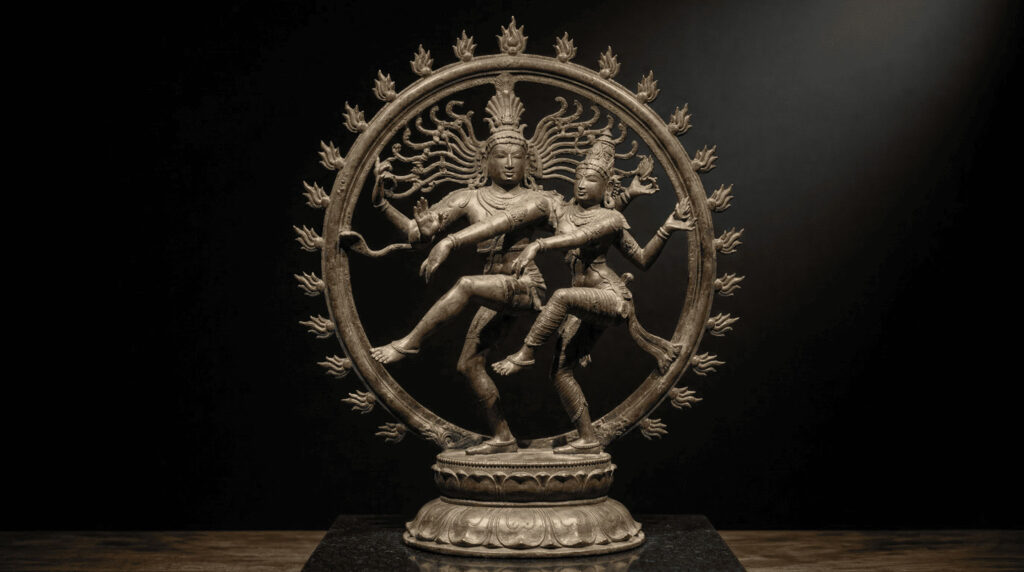
What is Tantra? Demystifying the Path of Conscious Aliveness
Category: Philosophy & Inner Alchemy Read Time: 4 minutes
If you were to ask a search engine, “What is Tantra?“, the results would likely reflect the modern world’s fragmented understanding of the word. You would find an overwhelming emphasis on esoteric sexual techniques, sensationalized practices, and promises of heightened physical pleasure.
But beneath the noise of pop culture lies a profound, ancient science of consciousness. To understand what Tantra truly is, we must strip away the modern embellishments and return to its origins.
We must return to the body. We must return to the breath.

The Loom of Reality
The word Tantra originates from the ancient Sanskrit root tan, which translates to “to weave,” “to stretch,” or “to expand.”
Imagine a master weaver working at a loom. The threads of the warp and weft come together to create a unified tapestry. In the same way, the philosophy of Tantra views the universe—and the human experience—as an intricately woven fabric. It teaches us that there is no separation between the mind and the body, between the sacred and the mundane, or between ourselves and the world around us.
Historically, many spiritual traditions have proposed a path of asceticism—the idea that to reach the divine, one must transcend, deny, or escape the physical body and its desires. Tantra offers a radically different, deeply loving proposition: The divine is not found by escaping the body, but by descending fully into it.

The Intelligence of Eros
It is impossible to speak of Tantra without addressing the aspect that the West has fixated upon: sexual energy.
Does Tantra involve sexuality?
Yes. But it does not view it merely as a pursuit of fleeting physical pleasure. In the Tantric perspective, sexual energy—Eros—is recognized as the fundamental life force. It is the raw, potent vitality that creates and sustains life.
When we approach this energy with absolute sobriety, awareness, and respect, it ceases to be a mere biological drive. It becomes a powerful tool for inner alchemy. By cultivating our life force rather than simply discharging it, we can burn through emotional blockages, heal deep somatic conditioning, and access expanded states of mental clarity.
Tantra is not about learning how to perform; it is about learning how to feel. It is the transition from a mechanical, numbed existence into a state of profound, sensual presence.
The Alchemy of Inclusion
At its core, the practice of Tantra is an act of radical inclusion. It asks us to stop fighting ourselves.
When we feel grief, we breathe into it. When we feel desire, we observe it without shame. When we feel joy, we let it expand through our nervous system. We use breathwork, meditation, and somatic (body-based) practices to create a safe vessel capable of holding the full spectrum of the human experience.
It is a highly practical, experiential path. It requires academic rigor of the mind to understand our patterns, but it demands the poetry of the heart to actually transform them.

An Invitation to Remember
Ultimately, Tantra is not something you “do.” Tantra is a state of being that you remember.
In our modern lives—characterized by speed, digital abstraction, and constant external demands—we often live entirely from the neck up. We become disconnected from the innate aliveness that hums beneath our skin.
To walk the Tantric path is to slowly, deliberately, and lovingly return home to yourself. It is the realization that everything you are seeking—the intimacy, the peace, the vital fire, the divine connection—is already woven into the very fabric of your being, waiting to be illuminated.